
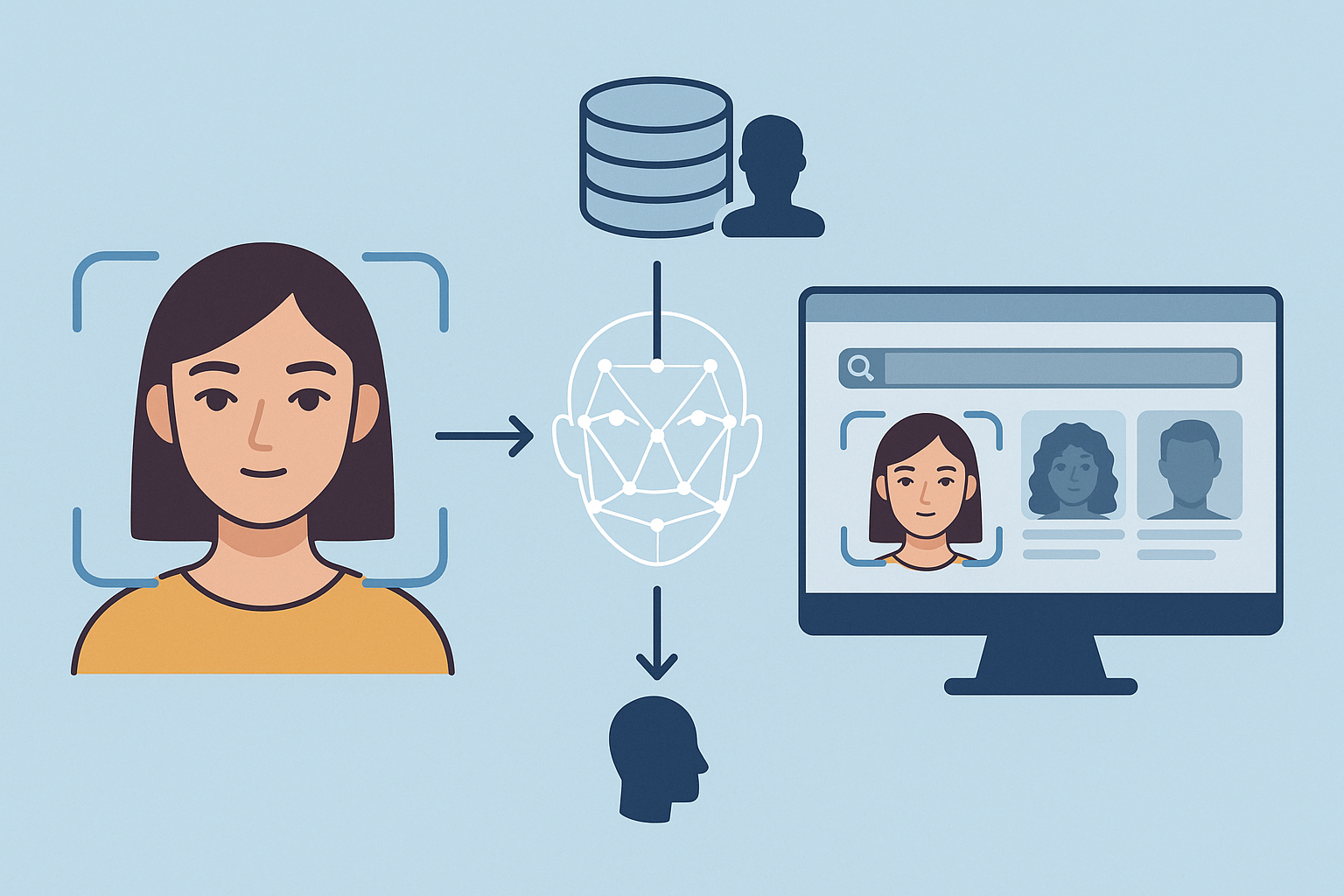
How Facial Recognition Search Actually Works: A Simple Explanation
Facial recognition search has rapidly evolved from science fiction to an everyday technology. But how does it actually work? It might seem like magic, but the process is based on clever algorithms and advanced AI. This guide breaks down the core concepts in a simple, understandable way.
What is Facial Recognition?
At its heart, facial recognition is the process of identifying or verifying a person from a digital image or video frame. It's a type of biometric technology, meaning it relies on unique biological characteristics to identify individuals.
The technology has two primary functions:
- Facial Detection: Identifying that a face is present in an image or video.
- Facial Recognition/Verification: Matching the detected face to a known identity in a database.
The Steps Involved: A Simplified Overview
Let's break down the facial recognition process into simpler steps:
1. Face Detection
The first step is locating faces within an image or video. This is often done using algorithms that scan the image for patterns resembling facial features like eyes, nose, and mouth. Think of it like a very sophisticated "find the face" game. Once a face is detected, it's isolated and prepared for the next stage.
Example: Face detection identifies the presence of faces in an image.
2. Face Analysis (Feature Extraction)
This is where the magic really happens. The system analyzes the detected face and identifies key facial landmarks and features. These features include:
- Distance between the eyes
- Width of the nose
- Depth of the eye sockets
- Shape of the cheekbones
- Length of the jawline
The algorithm measures these features and creates a unique numerical representation of the face, often referred to as a "faceprint" or "facial signature." This faceprint is a mathematical code that represents the unique characteristics of that specific face.
Example: Facial landmarks are identified and measured to create a unique faceprint.
3. Faceprint Creation
The extracted features are then converted into a unique digital code – the faceprint. This faceprint is a highly compressed representation of the facial features, designed for efficient comparison.
4. Face Matching (Comparison)
This is the final step. The newly created faceprint is compared against a database of existing faceprints. The algorithm calculates a similarity score, which represents how closely the new faceprint matches the faceprints in the database.
If the similarity score exceeds a certain threshold, a match is declared. The higher the score, the more confident the system is that it has found the correct person.
Example: Faceprints are compared to find the closest match in a database.
The Role of AI and Machine Learning
Modern facial recognition systems rely heavily on AI, particularly deep learning. Deep learning algorithms are trained on massive datasets of faces, allowing them to learn complex patterns and features that would be impossible for humans to program manually. This allows the system to become more accurate and robust over time, even when dealing with variations in lighting, pose, and expression.
These AI-powered systems are also much better at handling challenges such as:
- Occlusion: Partial obstruction of the face (e.g., wearing glasses or a hat).
- Variations in lighting: Different lighting conditions can affect the appearance of a face.
- Changes in pose: Faces can appear different depending on the angle from which they are viewed.
- Ageing: Faces change over time.
How MambaPanel Utilizes Face Search Technology
At MambaPanel, we leverage this powerful technology to provide accurate and comprehensive face search capabilities. Our database contains over 7 billion faces, allowing our users to find individuals across the internet with remarkable precision. We continuously refine our algorithms using the latest advancements in AI to ensure the highest possible accuracy and efficiency. Our 99.9% uptime guarantees reliable access to our service whenever you need it.
MambaPanel's technology is particularly useful for:
- Finding public profiles: Quickly locate social media accounts and other online profiles associated with a particular face.
- Investigating potential connections: Discover relationships between individuals by searching for shared images.
- Verifying identities: Confirm the identity of someone you've met online.
The Future of Facial Recognition
Facial recognition technology is constantly evolving. Future advancements are likely to focus on improved accuracy, enhanced privacy protection, and new applications in areas such as healthcare, security, and personalized experiences.
Understanding the underlying principles of facial recognition empowers you to make informed decisions about its use and potential impact. It's a powerful tool with the potential to improve many aspects of our lives, but it's important to be aware of both its capabilities and its limitations.
Want to see it in action?
Try MambaPanel's Free Face Search
AUTHOR: MambaPanel Team