
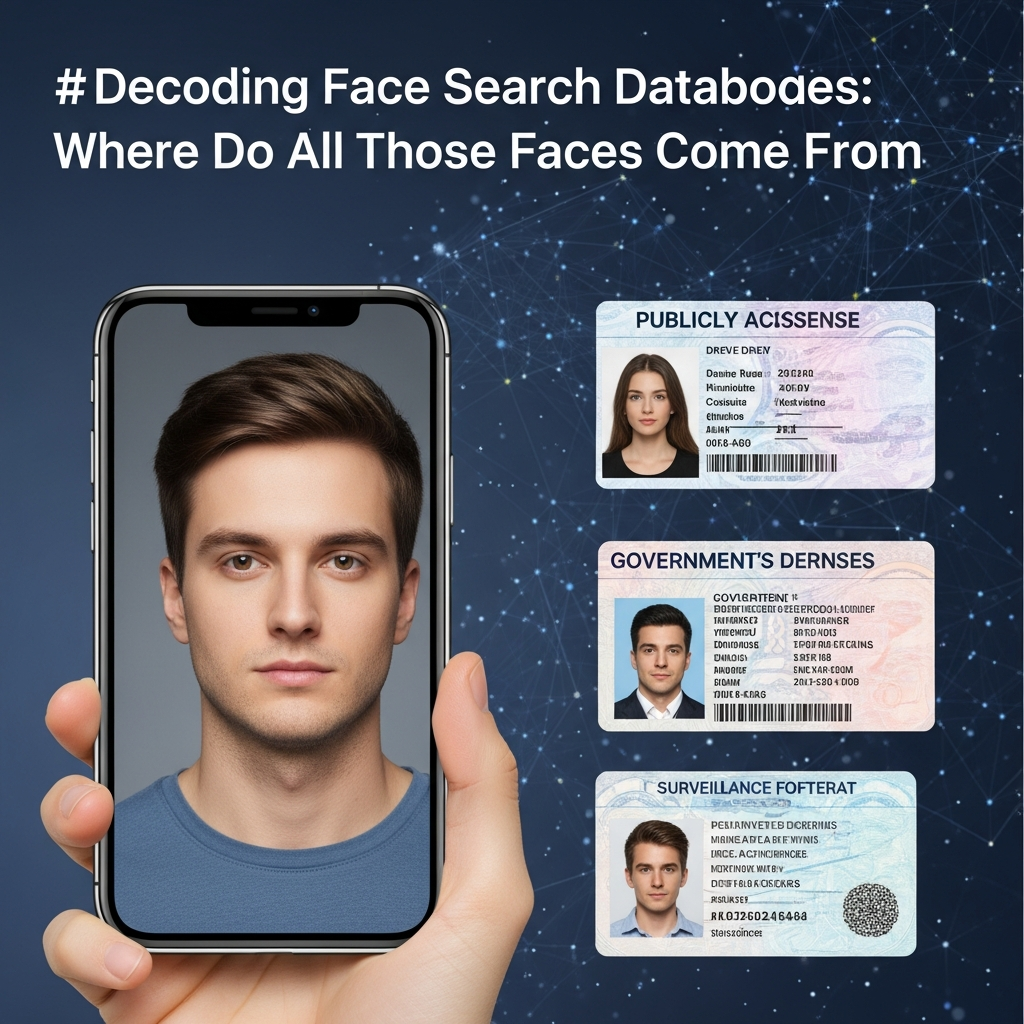
Decoding Face Search Databases: Where Do All Those Faces Come From?
In today's interconnected world, facial recognition technology is rapidly evolving. Face search engines, like MambaPanel, offer powerful tools for identifying individuals from just a photograph. But have you ever stopped to wonder how these services manage to recognize faces with such accuracy? The answer lies in the vast and complex databases they utilize. This article delves into the world of face search databases, exploring their construction, data sources, and the technology that powers them.
The Foundation: Building a Massive Image Index
At its core, a face search engine relies on a massive index of facial images. This index isn't just a collection of photos; it's a meticulously organized and searchable database where each face is represented by a unique set of mathematical features. The process of building this database typically involves the following steps:
- Data Collection (Scraping): The initial and arguably most crucial step is gathering images from publicly accessible sources. This often involves web scraping, a technique used to automatically extract data from websites.
- Face Detection: Once the images are collected, the system needs to identify and isolate the faces within each image. This is achieved using face detection algorithms, which are trained to recognize facial patterns and features.
- Facial Feature Extraction: After a face is detected, the system extracts key facial features, such as the distance between the eyes, the shape of the nose, and the contours of the mouth. These features are then converted into a numerical representation, often referred to as a "faceprint" or "facial embedding."
- Indexing: The facial embeddings are then stored in a searchable database, allowing the system to quickly compare a query face against the millions or even billions of faces in the index.
Where Do Face Search Engines Get Their Data?
The question of data sources is central to understanding how face search engines operate. Here's a breakdown of the most common sources:
- Social Media Platforms: Social media platforms are a treasure trove of publicly available images. Platforms like Facebook, Instagram, Twitter, and LinkedIn often contain profile pictures and shared photos that can be scraped for facial data. It's important to note that the terms of service of each platform dictate what data can be legally accessed and used.
- Public Websites: Many websites, including news outlets, company websites, and online forums, feature images of individuals. These images can also be scraped and added to the database.
- News Articles and Media Outlets: News articles and online media frequently contain images of people involved in newsworthy events. These images are often publicly accessible and can be used to build the database.
- Government and Public Records: In some cases, publicly available government records, such as mugshots or driver's license photos, may be included in the database. However, access to and use of this type of data is often subject to strict legal regulations.
Example: Imagine a news article featuring a protest. A face search engine might scrape the article's images, detect the faces of the protestors, and add them to its database. Similarly, a company's "About Us" page with employee photos could contribute to the database.
MambaPanel's Approach to Face Search Technology
At MambaPanel, we understand the importance of a comprehensive and accurate face search database. Our 5-billion-image database is constantly growing, fueled by sophisticated scraping techniques and advanced AI algorithms. We prioritize accuracy and efficiency, ensuring that our users can quickly and reliably identify individuals from a single image. Our commitment extends to ethical considerations, striving to maintain compliance with data privacy regulations and promote responsible use of our technology.
MambaPanel utilizes advanced facial recognition algorithms to analyze and index the faces in our database. When a user uploads an image for search, our system extracts the facial features and compares them against the indexed faceprints. The system then returns a list of potential matches, ranked by similarity score.
The Role of AI and Machine Learning
Artificial intelligence (AI) and machine learning (ML) play a crucial role in the accuracy and efficiency of face search engines. AI algorithms are used for:
- Improved Face Detection: AI-powered face detection algorithms are more robust and accurate than traditional methods, allowing them to identify faces in a wider range of conditions, such as varying lighting, angles, and occlusions.
- Enhanced Feature Extraction: AI algorithms can extract more nuanced and informative facial features, leading to more accurate facial embeddings.
- Optimized Search and Matching: Machine learning algorithms can optimize the search and matching process, allowing the system to quickly identify the best matches from a massive database.
Ethical Considerations and Data Privacy
The use of face search technology raises important ethical considerations and data privacy concerns. It's crucial for face search engine providers to:
- Comply with data privacy regulations: Adhere to all applicable data privacy laws, such as GDPR and CCPA.
- Be transparent about data sources: Clearly disclose the sources of data used to build the database.
- Implement safeguards to prevent misuse: Develop and enforce policies to prevent the misuse of the technology for malicious purposes.
- Respect individual privacy rights: Provide individuals with the ability to request the removal of their images from the database.
Conclusion
Face search engines rely on massive databases built from publicly available images scraped from social media, websites, news articles, and other sources. These databases are constantly growing and evolving, thanks to advancements in AI and machine learning. While this technology offers powerful capabilities, it's essential to address the ethical considerations and data privacy concerns associated with its use. MambaPanel is committed to providing accurate and efficient face search services while upholding the highest ethical standards.
Our 5-billion-image database is always growing. Search it now.