
The New Architecture of Sound: An Intelligence Briefing on AI in the Music Industry
The music industry is undergoing a fundamental re-architecting at the hands of Artificial Intelligence. This is not an incremental evolution; it is a paradigm shift. AI has moved from a peripheral tool to a core operational layer, integrated into every facet of the creative and commercial lifecycle, from the genesis of a melody to its global distribution.
This is not a future-state projection. This is the deployed reality. This intelligence briefing will deconstruct the key vectors through which AI is systematically restructuring the modern music industry.
Vector 1: The Synthesis of Composition
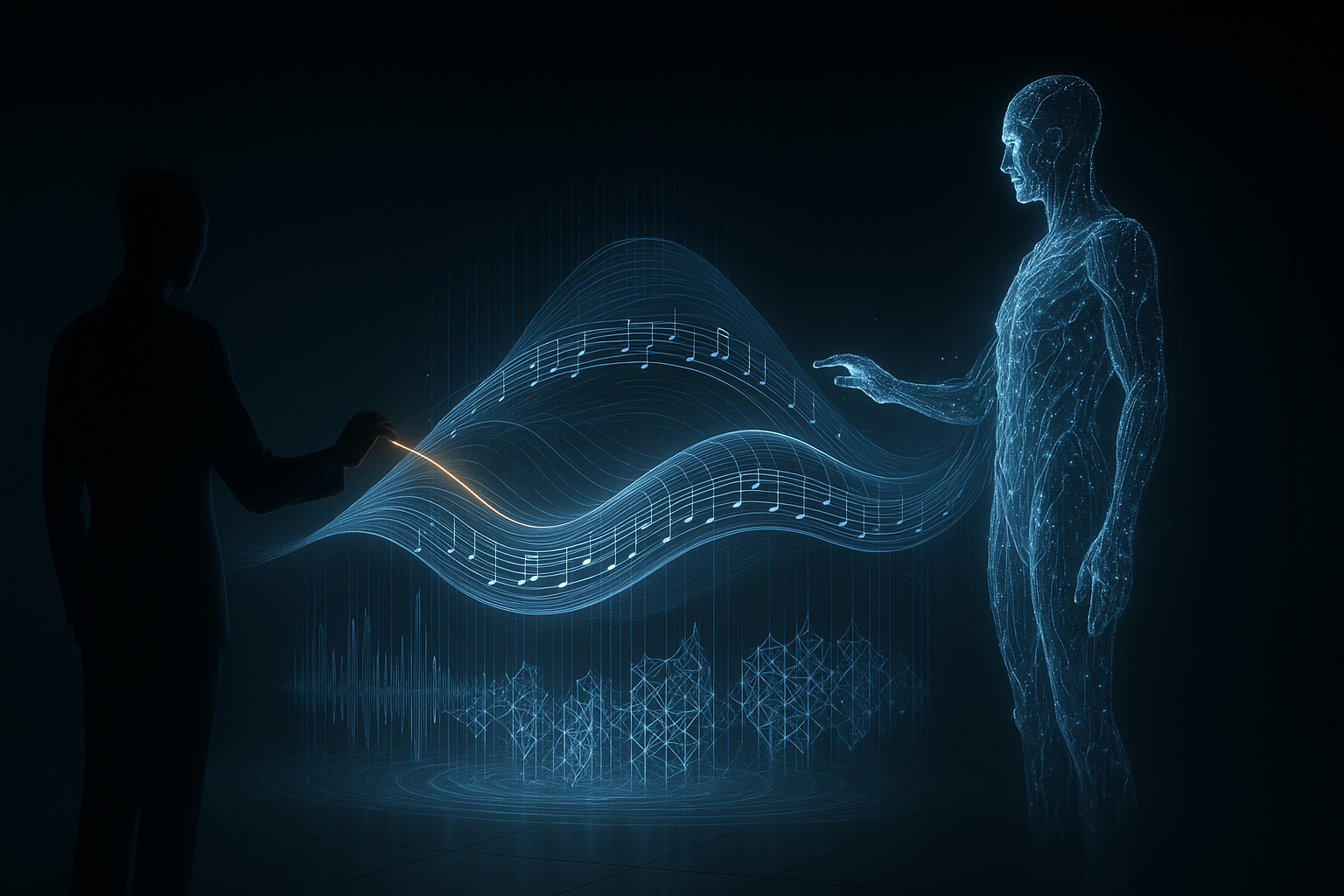
The act of musical creation, once the exclusive domain of human intuition, is now a symbiotic partnership between the artist and a cognitive engine. AI-powered generative models are capable of analyzing an artist's entire catalog, learning their unique stylistic parameters, and generating novel melodic structures, harmonic progressions, and rhythmic patterns that are both original and authentic to their voice.
Furthermore, AI-driven lyrical frameworks can now provide songwriters with sophisticated thematic and rhyming constructs, automating the foundational aspects of lyricism and allowing the artist to focus on the higher-order task of emotional and narrative refinement. This is not the automation of art; it is the augmentation of the artist.
Vector 2: The Automation of Post-Production and Engineering
The traditionally labor-intensive and time-consuming processes of sound engineering and mastering are being streamlined with surgical precision. AI-driven tools are now deployed to:
-
Analyze Audio Integrity: Meticulously scan raw audio tracks to detect imperfections, such as background noise or frequency imbalances, and suggest or execute precise corrections.
-
Optimize Sonic Fidelity: Utilize intelligent mastering algorithms to optimize the final mix for various distribution platforms, ensuring a consistent and high-quality listening experience across all endpoints.
This automation frees sound engineers from rote, repetitive tasks, allowing them to function as creative directors of the sonic landscape, rather than mere technicians.
Vector 3: The Algorithmic Architecture of Discovery and Distribution
The way music reaches its audience is now almost entirely governed by AI. The modern listener does not seek out music; it is delivered to them through a sophisticated, data-driven architecture of discovery.
AI algorithms power the personalized recommendation engines of major streaming platforms. By analyzing billions of data points—listening habits, skipped tracks, playlist additions—these systems build a precise psychographic profile of each user, serving them a continuous stream of content with a high probability of engagement. For artists and labels, AI-powered marketing tools analyze these same datasets to identify high-value target audiences and optimize promotional strategies, ensuring maximum impact and ROI for any given release.
Vector 4: The Future of Pedagogy and Therapeutic Application
Beyond the commercial sphere, AI is restructuring how music is learned and utilized.
-
In Education: Intelligent tutoring systems provide students with real-time, data-driven feedback on their performance, identifying errors and offering personalized exercises to accelerate the acquisition of skill.
-
In Therapeutics: AI is being used to analyze physiological responses to music, allowing for the creation of bespoke soundscapes designed to reduce stress, improve focus, or aid in physical rehabilitation.
Conclusion: The Inevitable Synthesis
The integration of Artificial Intelligence into the music industry is comprehensive, profound, and irreversible. It is the new operational standard. From the first note of a composition to the final analysis of its market performance, AI is the invisible architecture that underpins the entire system.
The future of sound is not a question of human versus machine. It is a synthesis of human artistry and algorithmic power, a new paradigm that will push the boundaries of creativity to an unprecedented scale.