
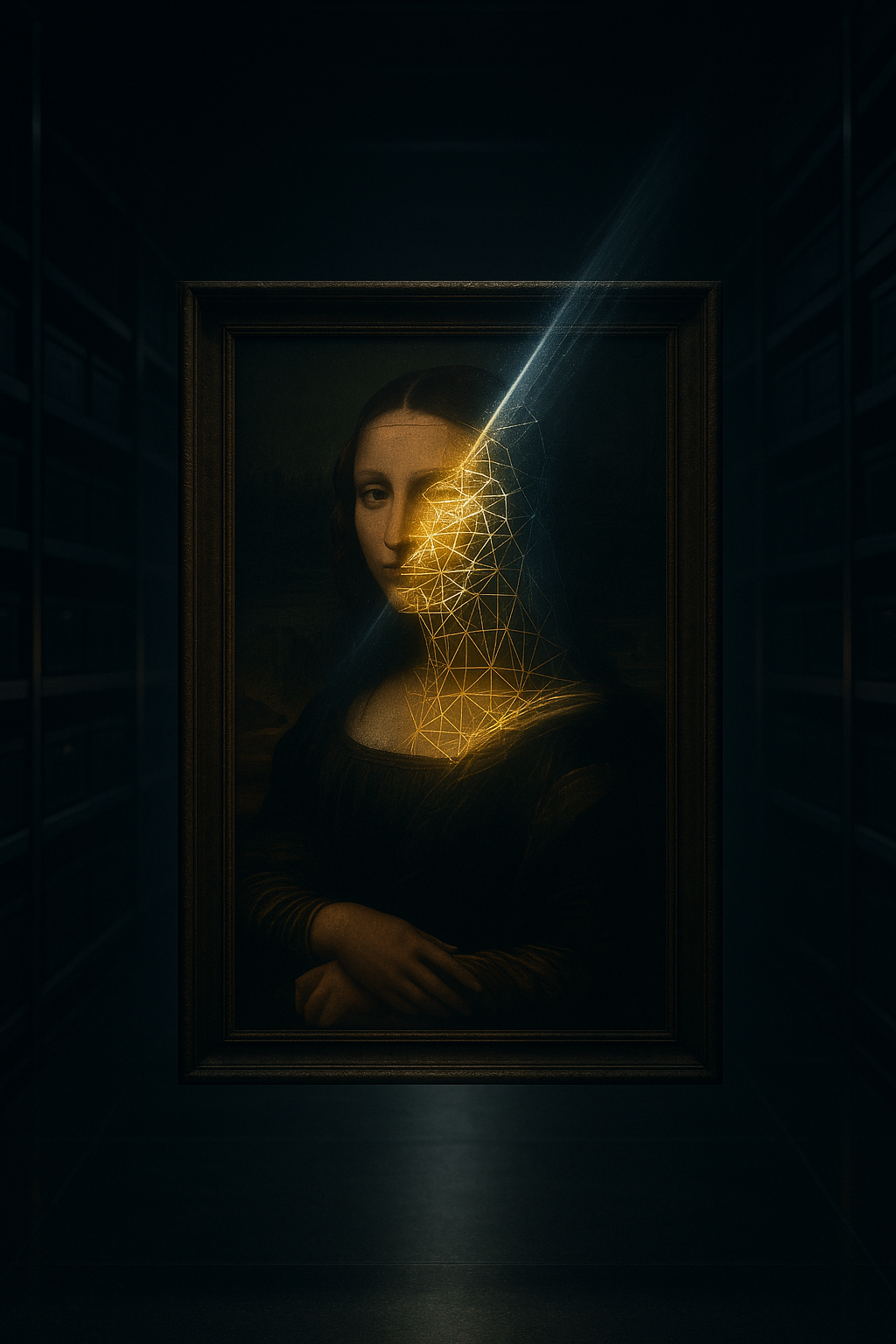
The Algorithmic Eye: Visual Intelligence and the Forensic Analysis of Art
The discipline of art history has always been, at its core, a forensic pursuit: a meticulous search for truth, provenance, and identity, conducted across centuries. For generations, its primary analytical tool was the connoisseur's eye—a remarkable but fundamentally subjective instrument, shaped by experience, intuition, and interpretation.
Today, a new, powerful paradigm is emerging. The integration of AI-powered visual intelligence is augmenting the connoisseur's eye with the objective, mathematical precision of the algorithm. This is not the automation of art history, but its evolution into a new data-driven discipline, capable of uncovering truths that have remained hidden in plain sight for generations.
From Subjective Interpretation to Data-Driven Authentication
The legacy methodology for identifying an unknown portrait sitter or authenticating a disputed work relies on a comparative analysis of stylistic tells—brushwork, composition, and period-specific details. While effective, this process is inherently vulnerable to subjective bias, expert disagreement, and sophisticated forgery.
Visual intelligence introduces an incorruptible layer of objective, quantitative analysis. The process is a model of forensic precision:
-
An artwork's portrait is scanned.
-
The AI engine performs a high-dimensional analysis of the subject's facial topology, creating a unique biometric signature.
-
This signature is then cross-referenced against a vast database of authenticated portraits, historical records, and other artworks.
This system can identify and compare thousands of unique data points in a facial structure, far beyond the capacity of the human eye. It can find a single recurring face across an artist’s entire body of work or detect minute, mathematically significant discrepancies between a forgery and an authentic masterpiece.
Strategic Application: Uncovering Hidden Networks and Histories
Perhaps the most transformative application of this technology is its ability to reveal previously unseen connections. By analyzing entire collections at scale, visual intelligence can function as a powerful network mapping tool.
It can identify a single, recurring model who appeared in the works of multiple artists across different cities, revealing the hidden social and professional networks of the era. It can trace the likeness of a historical figure from their first youthful portrait to their last, providing a definitive visual chronicle of a life. This capability moves beyond the analysis of a single artwork to the reconstruction of entire historical ecosystems.
Case Study: The Computational Authentication of a Raphael
A landmark case study in this new field is the authentication of the "de Brécy Tondo." Long suspected by its owner to be a lost work by the Renaissance master Raphael, the painting's attribution was the subject of intense debate among art historians.
Researchers deployed a sophisticated AI facial comparison system, analyzing the portraits of the Madonna and Child in the Tondo against those in Raphael’s authenticated masterpiece, the Sistine Madonna. The AI conducted a comparison across thousands of dimensions, revealing a 97% biometric similarity between the Madonnas—a statistically definitive match far exceeding the threshold for identical subjects. This computational verdict provided the objective, data-driven evidence needed to re-evaluate the painting's place in art history.
Operational Parameters and Future Trajectory
The efficacy of visual intelligence in art analysis is, of course, contingent on the quality of the source material. The degradation of older works, artistic stylization, and the comprehensiveness of available databases are all critical operational parameters.
However, these are not permanent limitations, but frontiers for advancement. As imaging technology improves and digital art archives expand, the accuracy and reach of these systems will only increase. The future of art history, authentication, and curation will be a symbiotic relationship between the trained human expert and the powerful, objective eye of the algorithm.
Visual intelligence is providing the tools to not only look at art, but to see through it, revealing the hidden data that tells its true story.