
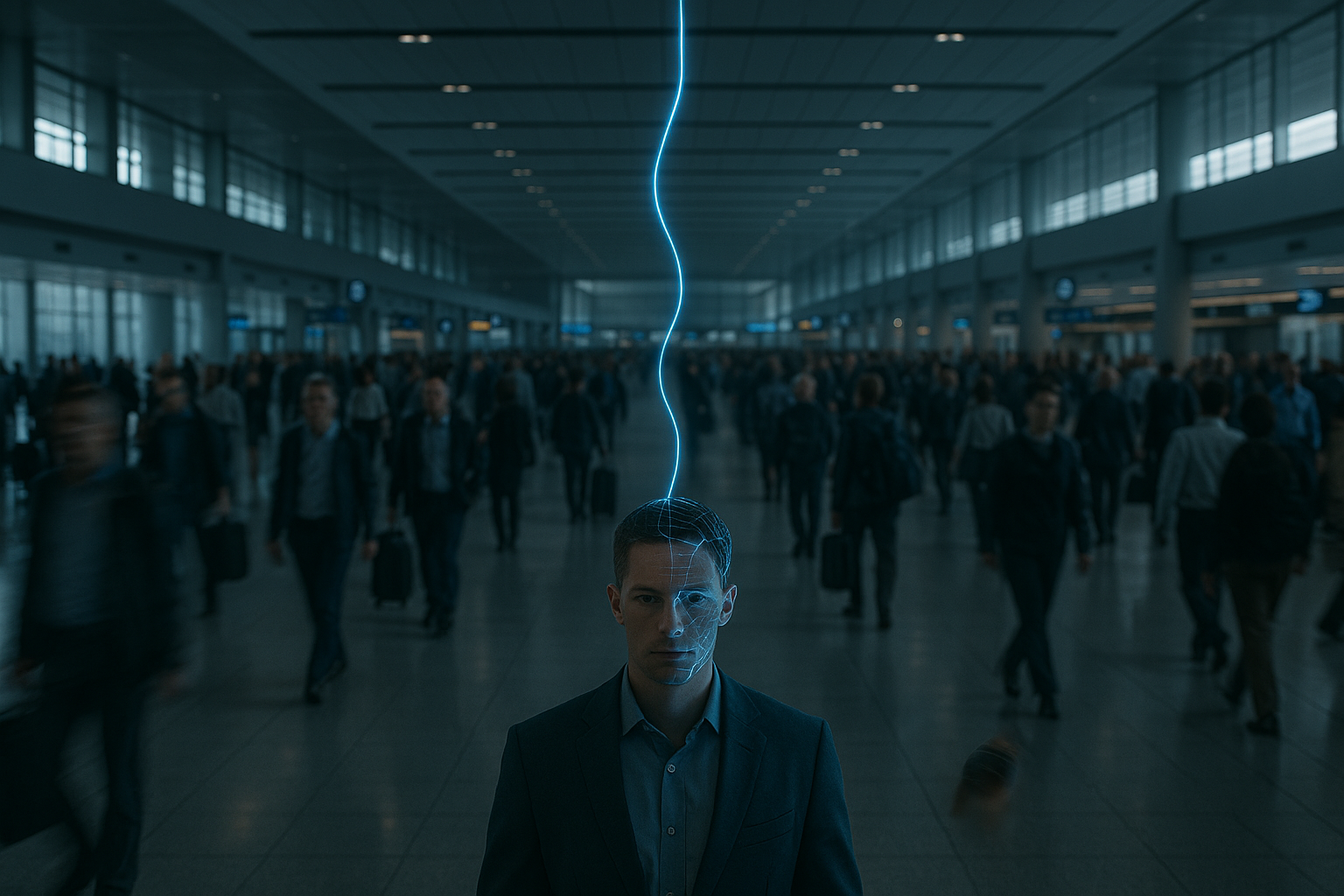
Securing Global Transit: The Role of Visual Intelligence in Transportation and Border Management
The security of global transportation networks represents one of the most complex and critical challenges of the modern era. These networks, airports, railways, and border crossings, are the arteries of international commerce and travel, demanding a security paradigm that operates at the intersection of maximum efficiency and uncompromising threat detection.
Artificial Intelligence, specifically in the form of advanced face search and visual intelligence, is no longer an emerging technology in this sector; it is the foundational architecture of the new security standard. This intelligence briefing will analyze the strategic deployment of AI in securing this critical infrastructure.
Application Vector 1: High-Throughput Identity Verification at Borders
The legacy model of border control, reliant on manual inspection of travel documents and subjective facial comparison, is fundamentally misaligned with the demands of modern transit volumes. It is a paradigm inherently constrained by the limits of human throughput and vulnerable to sophisticated document forgery and human error.
AI-driven verification protocols represent a quantum leap in both speed and accuracy. The process is a model of efficiency:
-
A passenger's face is scanned at an automated checkpoint.
-
The system converts key facial topology into a unique biometric signature.
-
This signature is cross-referenced against the encrypted data in their e-passport and checked against national and international watchlists in milliseconds.
This near-instantaneous, high-accuracy verification process does more than accelerate transit; it acts as a force multiplier. By automating the high-volume, low-complexity task of identity verification, it liberates human border control officers to focus on higher-order threat analysis, anomaly detection, and direct interdiction. Operators like Singapore's Changi Airport have integrated these systems to fundamentally redesign the passenger experience, creating a more secure and frictionless journey.
Application Vector 2: Proactive Threat Detection in Transit Hubs
Beyond the border, the vast and porous environments of airports and major train stations present a distinct security challenge. Here, the objective shifts from identity verification to proactive threat detection and access control.
AI-powered visual intelligence systems are integrated into existing surveillance infrastructure to monitor these environments in real-time. These systems are not merely recording; they are actively analyzing, capable of:
-
Identifying Persons of Interest: Instantly matching individuals against curated watchlists of known threats, triggering silent alerts for security personnel.
-
Controlling Secure Zone Access: Utilizing biometrics as a key, ensuring only authorized personnel can enter restricted areas, thereby eliminating the risk of stolen or duplicated credentials.
-
Detecting Anomalous Behavior: Learning patterns of normal crowd flow and flagging deviations that may indicate a developing security situation.
Major transit hubs, from London's King's Cross Station to international airports worldwide, have deployed this technology to move from a reactive security posture to one of proactive, intelligence-led defense.
Operational Considerations and the Path to Refinement
The deployment of any mission-critical technology requires a rigorous understanding of its operational parameters. The primary challenges in visual intelligence are algorithmic bias and accuracy under variable conditions (e.g., poor lighting, low-quality imagery).
Addressing these challenges is a core focus of the industry's continuous refinement process. The path forward involves a commitment to:
-
Diverse and Expansive Training Datasets: Ensuring algorithms are trained on data that reflects global demographics to mitigate and eliminate bias.
-
Multi-Factor Authentication: Integrating visual intelligence as one powerful layer within a broader security framework.
-
Ethical Oversight and Transparency: Adhering to stringent data protection regulations and maintaining clear policies on the use and retention of biometric data.
The Future Trajectory: An Integrated, Secure Journey
The evolution of visual intelligence in transportation is moving toward a single, integrated, and secure passenger journey. The future paradigm will see a traveler move seamlessly from their arrival at the airport to their seat on the plane, their identity verified at each checkpoint through passive, frictionless biometric scanning.
This is not a distant vision; it is the active trajectory of the industry. AI-powered visual intelligence is the cornerstone of this new security architecture, promising a future of global travel that is simultaneously safer, faster, and more efficient.