
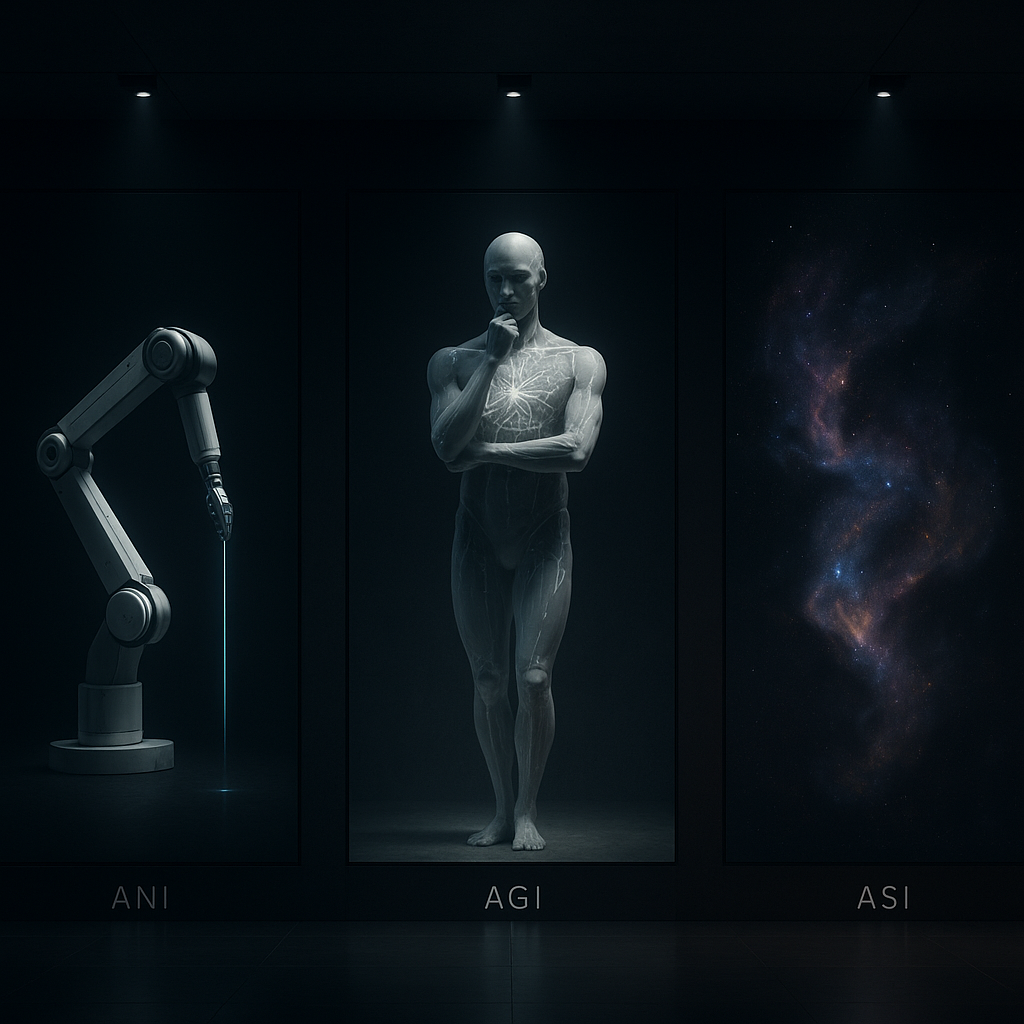
An Intelligence Briefing on the Three Tiers of Artificial Cognition
The term "Artificial Intelligence" is a monolith, a singular label for a vast and deeply stratified technological landscape. Public discourse often conflates the practical, deployed systems of today with the theoretical, speculative constructs of tomorrow. This lack of precision fuels misunderstanding and obfuscates the true nature of the technology's current capabilities and future trajectory.
A clear, strategic understanding of AI requires a tiered classification. This intelligence briefing will deconstruct the three distinct tiers of artificial cognition: Narrow, General, and Superintelligence.
Tier 1: Artificial Narrow Intelligence (ANI) — The Deployed Reality
This is the domain of the present. ANI, or "weak AI," refers to systems engineered to execute a specific, highly-defined task with superhuman efficiency and accuracy. This is the intelligence of the specialist.
The MambaPanel platform is a prime example of a sophisticated ANI. Our deep learning engine is one of the most powerful visual intelligence tools in the world, but its function is singular: to execute a high-speed, high-accuracy reverse image search across the open web. It is a master of its designated craft.
This tier encompasses the vast majority of AI in operation today:
-
Virtual Assistants: Processing natural language to execute commands.
-
Recommendation Engines: Analyzing user data to predict preferences, as seen in platforms like Netflix.
-
Image and Speech Recognition: Identifying patterns in visual or auditory data for applications ranging from medical diagnostics to security.
The power of ANI lies in its focused excellence. It is a cognitive tool, but it operates within the strict, immutable boundaries of its design. It cannot learn, reason, or adapt outside of its specified domain.
Tier 2: Artificial General Intelligence (AGI) — The Developmental Horizon
This is the domain of the near future. AGI, or "strong AI," represents the theoretical advent of a machine possessing human-level, generalized intelligence. This is the intelligence of the polymath.
An AGI would be capable of understanding, learning, and applying its intellect to solve any problem a human can, moving fluidly between disparate domains without requiring specific pre-programming for each new task. It would be capable of reason, abstract thought, and creative problem-solving on par with a human expert.
The development of AGI is the primary objective of many of the world's leading research institutions and technology firms. While significant progress is being made, true AGI remains a developmental challenge of immense complexity. It is not currently deployed, but it represents the active, strategic horizon of AI research.
Tier 3: Artificial Superintelligence (ASI) — The Theoretical Singularity
This is the domain of the distant future. ASI is a hypothetical form of intelligence that would not merely match, but exponentially surpass, the brightest human minds in virtually every field. This is the intelligence of the transcendent.
An ASI would possess the capacity for recursive self-improvement, accelerating its own cognitive development at a rate that is difficult to comprehend. Such an entity could potentially solve humanity's most intractable problems, from disease to climate change.
Simultaneously, the emergence of ASI presents profound and existential questions of control, ethics, and governance. At present, ASI remains firmly in the realm of theoretical science and philosophical debate. It is the ultimate, and most consequential, extrapolation of the AI trajectory.
Conclusion: A Framework for Clarity
Understanding this tiered framework is essential for any rational discussion of Artificial Intelligence. The ANI systems of today, including powerful investigative tools like MambaPanel, are not nascent versions of AGI or ASI. They are highly specialized instruments, operating under the direct control and within the defined parameters set by their human architects.
By maintaining a clear, precise, and unsensational understanding of what AI is today, we can more effectively and responsibly guide its development toward what it will become tomorrow.